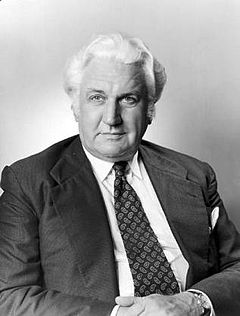
Gough Whitlam became Prime Minister of Australia on 5 December 1972. A lot of Australians thought that after 23 years of Opposition, The Labor Party would lead Australia into an exciting new era of reform and achievement.
The Labor Party was in government because it won a majority of seats in The House of Representatives. It did not have the majority vote in the Senate so they could not guarantee that its Bills would be passed. In March 1974, the Liberal and Country parties threatened to refuse to pass the government's Supply Bills in the Senate, even though after 74 years of history it had become a custom to always pass the Supply even if it had numbers to reject the bill.
Whitlam then called for an early election and he hoped to win precedent in both The House of Representatives and the Senate but the same thing happened.
John Kerr had been Governor General since 11 July 1974. Whitlam had nominated him for the position and Queen Elizabeth II appointed him on the basis of Whitlam's nomination.
Kerr was faced with the decision during this crisis of the bill and the supply. Malcolm Fraser began trying to influence Kerr to break this by sacking the Prime Minister and his government. Bob Ellicott issued a statement saying that Kerr had the right to do this if the government could not ensure Supply.
Kerr appears to have made up his mind on 9 November to dismiss Whitlam. He felt it necessary not to disclose this intention to Whitlam and his ministers because of his fear that Whitlam would advise Queen Elizabeth II to exercise her constitutional power to terminate Kerr's commission as Governor-General. In so doing, Kerr was aware of the precedent set by Sir Philip Game, the Governor of New South Wales, who had dismissed Jack Lang's government in 1932. Game had warned Lang in advance that if he, Lang, did not withdraw certain regulations, then he, Game, would dismiss him. This allowed Lang to seek Game's dismissal if he dared, which he did not.
On the morning of Tuesday, 11 November, Whitlam phoned Kerr and arranged to see him at 12.45pm after the Remembrance Day ceremonies. Kerr also arranged for Fraser to come "a quarter of an hour later. Mr Fraser was not told why I wanted him to come." Fraser later claimed that Kerr telephoned him and asked him whether, if he were commissioned as Prime Minister, he would:
- pass the budget bills,
- call an immediate double dissolution election for both houses of Parliament, and
- make no appointments, initiate no new policies, and conduct no inquiries into the previous government, before such an election.