In 1968, Jack Mundey was elected secretary of the NSW Builders' Labourers Federation (BLF). From this position, Mundey became the someone who, with his union and supportive community members, was responsible for the green bans that saved much of Sydney's heritage and built environment. He insisted that the priorities of development be reversed so that the open community spaces and heritage buildings be preserved and that affordable public housing was more important than accumulating empty or underused commercial buildings. In 1975 Mundey and other NSW leaders of the BLF were expelled from the union by the federal leadership under Norm Gallagher. Gallagher was later jailed for taking bribes from developers. The BLF was involved in many more green bans. Not only did the BLF represent all unionised builders' labourers in the construction industry; but the BLF also influenced the opinion of other unionised construction workers, and acted as a political leadership of the construction unions in the era. Forty-two bans were imposed between 1971 and 1974. Green bans helped to protect historic nineteenth century buildings in The Rocks from being demolished to make way for office towers, and prevented the Royal Botanic Gardens from being turned into a carpark for the Sydney Opera House. One of the last bans to be removed was to prevent development of Victoria Street in the suburb of Potts Point. This ban involved hundreds of residents, trade union members, and other activists and was successful for a number of years. The green ban was broken in 1974 when the conservative federal leadership of the BLF, under pressure from New South Wales politicians, dismissed the leaders of the New South Wales branch, and replaced them with more conservative people who did not support the ban. Activists, led by activist, resident, and journalist Juanita Nielsen, then convinced another union, the Water Board Employees Union, to impose a ban which was continued for some time. 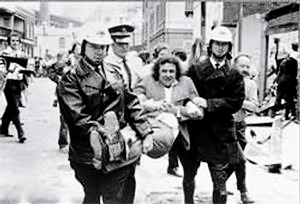 |
Before the green ban era, people used to think that only upper-middle-class and wealthier Australians cares about the environment and that the environment was really only 'nature'. The green bans showed that the built environment was important too and that its development was a concern for Australians everywhere. Jack Mundey,the BLF members and their green bans supporters demonstrated the impact of people working together for a common cause. Also that Australian citizens are concerned with maintaining their built and environmental heritage. As well as that the NSW BLF'S commitment in the early 1970s to using its union strength in support of causes beyond pay and conditions issues. The green bans did actually create a legacy that lived on even after they stopped. Ever since the first green bans, town planners, developers and councils have become more aware of the impact of building plans on streetscapes and more concerned with the overall impact of their projects. |
